21X has become the first company to receive a BaFin-issued license for a fully regulated blockchain-based trading and settlement system. This marks a pivotal moment for European capital markets, highlighting the growing momentum of distributed ledger technology (DLT) in the financial sector.
The company plans to launch its Frankfurt-based platform in Q1 2025, enabling the trading of tokenized assets, including securities, funds, and real-world assets, all within the robust regulatory framework established by the EU.
As a leading RegTech provider, LPA Lucht Probst Associates has long supported international asset managers in navigating regulatory compliance and automating reporting processes, particularly for high-growth areas such as ETPs and ETNs. We congratulate 21X on this milestone, which will shape the future of tokenized capital markets.
The European Securities and Markets Authority (ESMA) has recently introduced updated guidelines for cross-border distribution of funds, emphasizing transparency and investor protection in marketing communications. The new framework highlights several key areas:
Identification of Marketing Communications
Marketing materials for UCITS and AIFs must secure prior regulatory approval when required. Such communications must explicitly state they are marketing in nature, using terms like “Marketing Communication” or concise tags like “#MarketingCommunication” on platforms such as social media. Investors are directed to refer to the fund’s prospectus or related documentation for detailed insights. Disclaimers must be clearly integrated, such as within videos rather than appended at the end.
Description of Risks and Rewards
Both risks and rewards must be presented equally and fairly, avoiding techniques like footnotes to downplay risks. These elements should be displayed side by side or in a manner that ensures equal prominence, leveraging tables or lists for visual clarity.
Fair, Clear, and Non-Misleading Communication
Marketing content must align with the knowledge level of its target audience. Retail-focused material should avoid technical jargon and ensure consistency with regulatory documents. Claims must be backed by verifiable sources, with balanced and accurate representations of fund features. Misleading comparisons or overpromising are strictly prohibited.
Cost, Performance, and Sustainability
Cost implications must be detailed, showing their effect on returns, particularly in foreign currency contexts. Performance claims should span 5–10 years and avoid unrealistic forecasts. Sustainability aspects must be truthful, matching the fund’s strategy without exaggeration.
The ESMA guidelines aim to enhance investor trust by ensuring marketing communications are transparent, balanced, and closely tied to regulatory disclosures.
We at LPA are your trusted partner in navigating regulatory changes, providing expert guidance to asset managers to ensure compliance and optimize operations in a dynamic landscape.
1. Strengthened Trading Controls and Professional Client Assessment
Directive (EU) 2024/790 (MiFID II Review) introduces mandatory disclosures about the circumstances leading to trading halts or constraints, enhancing transparency in market disruptions as part of the requirements concerning Systems resilience, circuit breakers and electronic trading . A new provision allows investors to qualify as professional clients upon passing a test proving their understanding of transactions and associated risks. These changes aim to modernize trading practices while ensuring only knowledgeable clients access complex investment opportunities.
2. European Single Access Platform (ESAP) and Enhanced Market Reporting
3. Retail Investor Protections and Cross-Border Services Oversight
The EU Commission’s Retail Investment Package emphasizes retail investor protection by requiring firms to assess transaction appropriateness and document client approvals for risk warnings. Independent advisors recommending well-diversified, non-complex and cost-efficient instruments to retail clients are exempted from collecting informations about the clients knowledge and experience about the considered financial instrument or service. Additionally, firms serving over 50 cross-border clients must report detailed service scopes to their home NCAs, while ESMA develops centralized reporting databases. Member States are encouraged to promote financial education and provide clear channels for reporting regulatory infringements.
Navigating these regulatory shifts can be complex, but LPA is your trusted partner, ensuring compliance and strategic adaptation to these evolving frameworks.
The Prudential Regulation Authority (PRA) has unveiled its post-Brexit framework for insurance firms, finalizing the new rules under Policy Statement 15/24. The reforms emphasize safety, soundness, and a streamlined regime to enhance competitiveness and growth. This marks a pivotal shift for insurers, enabling productive investments and a dynamic UK insurance market from late 2024.
As a leader in financial services, LPA supports clients in navigating complex regulations with innovative, tailored solutions to future-proof their operations. Let’s shape the future together! #SolvencyUK #Innovation
Update CSSF document upload: New transmission procedures for asset managers
The CSSF (Commission de Surveillance du Secteur Financier) has fundamentally revised the procedures for transmitting the Key Information Document (KID) and other regulatory documents (MR/AI). These changes will enter into force on 15 November 2024 and affect all asset managers that manage or distribute funds in Luxembourg.
As already announced in the communication of 5 April 2024, two digital transmission methods will be available from this date to ensure a more efficient and secure exchange:
Document upload via eDesk: A dedicated portal through which documents can be manually uploaded and submitted directly to the CSSF.
Automated API transmission: For asset managers processing larger volumes of data, the CSSF offers an API-based solution via the S3 protocol. This enables direct, automated transmission.
Important information for asset managers
Exclusive use of the new channels: From 15 November 2024, the CSSF will only accept the transmission of documents via an eDesk or API channel.
Discontinuation of the old transmission methods: Documents submitted via the previous channels will no longer be considered! This requires rapid adaptation of internal processes to comply with the new standards.
What does this mean for asset managers?
Switching to the new procedures is not only a technical challenge, but also requires strategic decisions in process design. This is where we come in. With extensive experience in state-of-the-art technologies and the latest regulatory compliance requirements in asset management, we offer solutions that are specifically tailored to the needs of the industry:
Consultancy and implementation: support with the integration of the new API interface or the use of the eDesk portal.
Regulatory compliance: Ensuring that all CSSF requirements are met.
Technological customisation: Development of customised IT solutions that can be seamlessly integrated into existing systems.
Efficient and future-proof with LPA
The CSSF’s new transmission procedures offer the opportunity to digitalise processes and make them more efficient in the long term. With our services, we help you to successfully implement this changeover and ensure regulatory compliance.
Contact us to optimise your processes in line with the new requirements.
LPA – your partner for innovative and sustainable asset management solutions.
The Commission Delegated Regulation (EU) 2024/2759, which supplements the revised ELTIF 2.0 regime (ELTIF RTS), was published in the Official Journal of the EU on 25 October 2024 and takes effect on 26 October 2024. This supplement specifies new responsibilities for ELTIF managers, including product lifecycle management, minimum holding periods, redemption policy requirements, cost disclosure, AIFM/AIFMD Reporting, and risk-liquidity assessments. This long-awaited update aims to facilitate retail investor access to ELTIF products while providing greater flexibility in asset selection.
Key Takeaways from ELTIF 2.0:
Lifecycle Procedures: ELTIF managers shall consider the lifecycle and characteristics of assets to be aligned with the ELTIF’s lifecycle.
Use of Derivatives: Solely economically suitable derivatives for hedging purposes are allowed.
Minimum Holding Period and Redemption Policy: Must align with the ELTIF’s structure and target investor type (primarily retail investors), with maximum redemption limits specified in Annexes I & II. A transfer request matching mechanism is allowed, with details disclosed in a clear, non-technical manner for retail investors.
Matching Requirements: Content requirement for full or partial matching of transfer requests to ensure fair and orderly transactions, considering the fund’s liquidity and redemption policies.
Risk and Liquidity Requirements: Outlines criteria for determining the liquid assets percentage in an ELTIF to meet redemption requests. These criteria consider factors like the ELTIF’s lifecycle, investment strategy stability, and potential market conditions impacting redemptions.
Cost Disclosures: Costs borne directly or indirectly by investors must be disclosed following the standardized approach defined in Article 12.
KID Requirement: Key Information Document (KID) required for retail distribution to provide appropriate transparency and customer protection.
At LPA, we understand the importance of staying up-to-date with the regulatory landscape. The Capmatix AM product line facilitates key fund reportings, including AIFM/AIFMD reporting, and document generation to support compliance.
Prepare for 2025 and always be up to date – Sign up for our free Regwatch newsletter!
The European Banking Authority (EBA), European Insurance and Occupational Pensions Authority (EIOPA), and European Securities and Markets Authority (ESMA) recently published the Final Report on draft Implementing Technical Standards (ITS) for the European Single Access Point (ESAP). This report outlines the requirements for entities to submit specific financial and sustainability-related information in compliance with the ESAP, aimed at increasing transparency and standardizing access to crucial regulatory information.
The ITS mandates that collection bodies submit data related to Prospectuses and key information disclosures required under the Sustainable Finance Disclosure Regulation (SFDR). These include details on sustainability risk policies applied within investment decisions, the adverse impacts at the entity and group levels, and sustainability-related product disclosures. Additionally, entities must report on Product Intervention and Product Rules (PRIIPs) and the Markets in Crypto-Assets Regulation (MiCAR). For MiCAR compliance, submissions should include a Crypto-asset white paper for assets that are neither e-money tokens (EMT) nor asset-referenced tokens (ART), as well as essential information regarding the issuer of ART/EMT and any relevant crypto-asset service providers.
The standards also establish the acceptable data formats to ensure consistency and accessibility. Article 2, paragraph 1, point (3) of Regulation (EU) 2023/2859 specifies the requirements for “data-extractable” formats, while Article 2, paragraph 1, point (13) of Directive (EU) 2019/1024 clarifies the criteria for “machine-readable” formats. According to these guidelines, HTML, PDF, and txt formats are deemed extractable as long as text within them is accessible for extraction. In contrast, machine-readable formats—such as XBRL, XBRL-XML, XBRL-CSV, and Inline XBRL—are required for their compatibility with software applications that facilitate data identification, recognition, and extraction.
By standardizing submission formats and procedures, the ESAP aims to create a more efficient, transparent, and technologically compatible system for information accessibility across the EU.
The Prudential Regulation Authority (PRA) is gearing up to release its long-awaited final Solvency II rules package in mid-November, set to go live on 31 December 2024. These landmark changes will reshape regulatory requirements for UK Solvency II firms, insurance groups, and select third-country branches.
The upcoming rules could require updates to existing PRA waivers and modifications, especially those tied to retained EU law and the PRA Rulebook. To ease the transition, the PRA will directly reach out to affected firms later this month with simple steps to align their compliance needs, ensuring a seamless shift to the new framework. Firms will have until 30 December to provide necessary consent, allowing uninterrupted compliance into the new year.
More details will soon be posted on the Bank of England’s website. Stay tuned!
Be compliant for 2025 – Sign up for our free Regwatch newsletter!
How the new TCC regulation will affect asset managers, brokers and investors – revolution or formality?
Together with Drescher & Cie, we cordially invite you to our event, which will focus on one of the most important topics for banks, asset managers and wealth managers in 2025: The new transaction cost calculation (TCC Arrival Price Method) for funds and ETFs. Be prepared and get a valuable head start in an increasingly competitive market.
What do banks, asset managers and wealth managers need to know and consider in 2025? Our experts Sebastian Höft, Global Director of Asset Management and Simon Blechinger , Product Manager Asset Management Solutions, from LPA Lucht Probst Associates will provide detailed insights and explanations of the new regulations and their impact on fund performance trends, for example. Find out how you can strengthen your competitive position through increased transparency and efficiently fulfil regulatory requirements.
Focus on the future of transaction costs for funds and ETFs
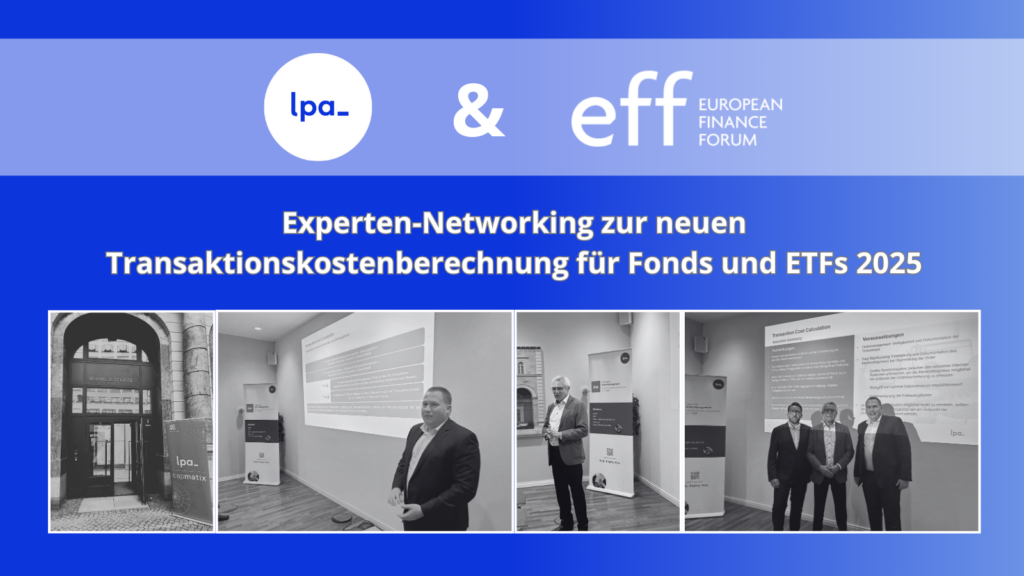
On 21 October, the European Finance Forum (EFF) took place in Munich, where we as LPA were represented by Sebastian Höft, our Global Director of Sales Asset Management, and our Product Manager Simon Blechinger, LL.M., M.Sc. The event attracted a high-calibre audience from the asset management and banking industry and provided an outstanding platform for academic exchange.
The discussion centred on the upcoming introduction of the new TCC transaction cost method of arrival prices for funds and ETFs, which will be applied from 2025. There was particular interest in how this methodology will affect the presentation of implicit costs. Our two speakers Höft and Blechinger shed light on key issues such as the frequency with which PRIIP KIDs will be created, which could be monthly or even more frequently in future.
An exciting aspect of the presentation was the presentation of initial research results, which suggested that corporate bond funds could probably become more cost-effective through the arrival price method. This represented a surprising advantage, while ETFs, which are considered favourable due to their high liquidity, may be more expensive in the implied cost presentation. These findings provide food for thought about the existing market mechanisms, even if they are not representative.
Our conclusion of the day? The new regulation poses major challenges for market participants and makes it clear that specialised technology companies such as LPA are essential in order to calculate PRIIP KIDs correctly and compliantly – precisely in the interests of the supervisory authorities and for professional fund advice and brokerage.
Networking was not neglected either: the evening ended with a cosy get-together in a relaxed atmosphere and great conversations. A big thank you goes to the team of the EFF European Finance Forum and the board members Rudolf Geyer and Dr Thomas Grauer – for the top organisation, the impressive premises in Munich’s Maximilianstraße and of course the excellent catering. We are already looking forward to the next joint event and highly recommend this format to everyone from the banking and capital market world!
See you next time and here’s to many more exciting insights!